

Draw Conclusion: Did The Cart Speed Up More Quickly With The Fan On Low Or Medium?
It may not seem like much, but driving even a few kilometres per hour above the speed limit greatly increases the adventure of an accident.
Many of us cheat a footling when driving. We figure that while the speed limit is 60 km/h the constabulary won't pull us over if nosotros sit on 65. So nosotros happily let the speedo hover only above the speed limit, unaware that by so doing we are greatly magnifying our chances of crashing.
Using data from actual road crashes, scientists at the University of Adelaide estimated the relative gamble of a auto condign involved in a casualty crash—a automobile crash in which people are killed or hospitalised—for cars travelling at or above 60 km/h. They plant that the risk approximately doubled for every 5 km/h to a higher place 60 km/h. Thus, a car travelling at 65 km/h was twice every bit likely to be involved in a casualty crash every bit one travelling at lx km/h. For a car travelling at seventy km/h the risk increased fourfold. For speeds beneath 60 km/h the likelihood of a fatal crash tin be expected to be correspondingly reduced.
Stopping distance calculator
Small conditions can make a large difference to the time it takes you to stop your car, such as going a few km/60 minutes slower or existence alert on the route.
Interactive
? km/h
? sec
? m/stwo
metres
travelled before automobile stops
metres
travelled earlier brakes are fully applied
metres travelled before machine stops
metres travelled before brakes are fully applied

The physics that drive you lot
Reaction fourth dimension
Ane reason for this increased take a chance is reaction time—the fourth dimension it takes between a person perceiving a danger and reacting to it. Consider this example. Ii cars of equal weight and braking power are travelling along the same road. Machine 1, travelling at 65 km/h, is overtaking Machine 2, which is travelling at threescore km/h. A child on a cycle—let's call him Sam—emerges from a driveway just as the two cars are side-by-side. The drivers both see the child at the aforementioned time and both take 1.v seconds before they fully apply the brakes. In those few moments, Motorcar one travels 27.one metres and Motorcar 2 travels 25.0 metres.
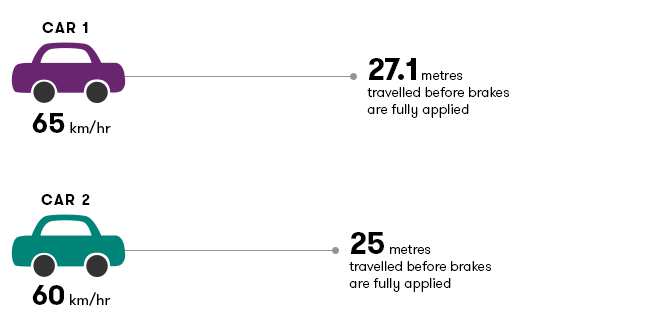
The divergence of two.1 metres might seem relatively small, just combined with other factors it could mean the difference betwixt life and decease for Sam.
The figure of i.5 seconds is the reaction time of average drivers. A commuter who is distracted, for example listening to loud music, using a mobile phone or has drunk alcohol may take as long equally 3 seconds to react.
Braking altitude
The braking distance (the altitude a auto travels earlier stopping when the brakes are practical) depends on a number of variables. The slope or course of the roadway is of import—a car will stop more apace if it is going uphill because gravity will assist. The frictional resistance betwixt the road and the car's tyres is also important—a car with new tyres on a dry road will be less probable to skid and will cease more quickly than one with worn tyres on a wet route. If slope and frictional resistance are equal, the gene that has near influence on braking distance is initial speed.
The formula used to calculate braking distance can be derived from a full general equation of physics:
$$V_{f}^{2} = V_{0}^{two} - 2ad$$
where 5f is the concluding velocity, V0 is the initial velocity, a is the charge per unit of deceleration and d is the altitude travelled during deceleration. Since we know that Vf will be zero when the car has stopped, this equation can be re-written as:
$$d = V_{0}^{ii} / 2a$$
From this we tin can encounter that braking distance is proportional to the foursquare of the speed—which means that it increases considerably equally speed increases. If we assume that a is 10 metres per 2nd per 2d and presume that the road is flat and the braking systems of the two cars are equally effective, we can now calculate braking distance for cars i and 2 in our example. For auto i, d = 16.3 metres, while for Motorcar ii, d = 13.nine metres.
Adding reaction distance to braking altitude, the stopping distance for Auto one is 27.1 + 16.3 = 43.4 metres. For Car two, stopping distance is 25 + 13.9 = 38.ix metres. Motorcar 1 therefore takes 4.5 more than metres to stop than Car two, a 12 per cent increase.
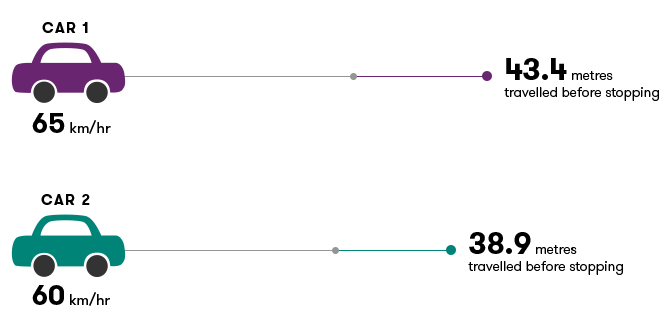
Nosotros can at present see why Automobile 1 is more than probable than Car ii to hitting Sam. If Sam is xl metres from the cars when the drivers come across him, Car 2 will stop just in time. Machine 1, though, will plough straight into him. By re-writing the first equation, we tin calculate the speed at which the standoff occurs:
$$V_{f} = \sqrt{V_{0}^{2} - 2ad} = 8.2\mbox{ }metres\mbox{ }per\mbox{ }second$$
(where d = forty metres minus the reaction altitude of 27.1 metres = 12.9 metres).
Thus, the affect occurs at nearly 30 kilometres/hour, probably fast plenty to kill Sam. If the car's initial speed was 70 kilometres/hour, the impact velocity would be 45 kilometres/hr, more than fast plenty to kill.
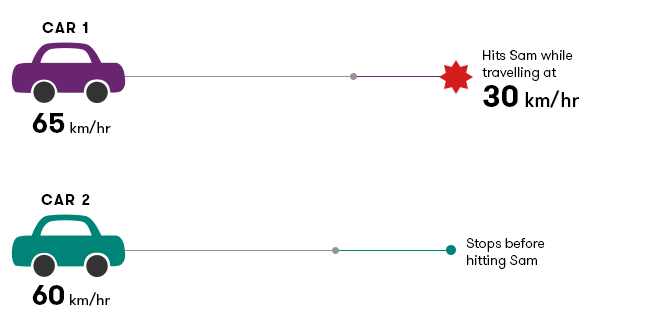
These calculations assume that the commuter has an average reaction time. If the commuter is distracted and has a longer than average reaction time, then he or she may hit Sam without having practical the brakes at all.
Bear upon on a pedestrian
Because the pedestrian, Sam, is then much lighter than the car, he has lilliputian effect upon its speed. The car, yet, very speedily increases Sam's speed from zero to the touch on speed of the vehicle. The fourth dimension taken for this is about the time information technology takes for the automobile to travel a distance equal to Sam's thickness—most 20 centimetres. The impact speed of Auto i in our instance is almost 8.2 metres per second, so the touch lasts only about 0.024 seconds. Sam must be accelerated at a charge per unit of about 320 metres per 2nd per 2d during this short fourth dimension. If Sam weighs 50 kilograms, so the forcefulness required is the product of his mass and his acceleration—near xvi,000 newtons or about 1.six tonnes weight.
Since the affect force on Sam depends on the affect speed divided by the impact time, it increases every bit the square of the impact speed. The impact speed, as we have seen in a higher place, increases rapidly equally the travel speed increases, considering the brakes are unable to bring the car to a terminate in fourth dimension.
Once a pedestrian has been hit by a automobile, the probability of serious injury or decease depends strongly on the touch speed. Reducing the impact speed from 60 to fifty kilometres/hour almost halves the likelihood of expiry, only has relatively little influence on the likelihood of injury, which remains shut to 100 per cent. Reducing the speed to 40 kilometres/hour, as in school zones, reduces the likelihood of death past a factor of iv compared with threescore kilometres/hour, and of course the likelihood of an touch on is also dramatically reduced.
Modernistic cars with low streamlined bonnets are more pedestrian-friendly than upright designs, such equally those found in four-bicycle drive vehicles, since the pedestrian is thrown upward towards the windscreen with a corresponding slowing of the impact. Cars with bull-bars are especially unfriendly to pedestrians and to other vehicles, since they are designed to protect their ain occupants with little regard for others.
Affect on a large object
If, instead of hitting a pedestrian, the machine hits a tree, a brick wall, or some other heavy object, so the car'southward energy of motion (kinetic free energy) is all dissipated when the auto body is bent and smashed. Since the kinetic energy (Eastward) is given by
$$E = (1/2)\mbox{ }mass × speed^{2}$$
it increases as the square of the impact velocity. Driving a very heavy vehicle does not lessen the outcome of the affect much considering, although there is more metal to absorb the affect energy, there is too more energy to exist absorbed.
Less command
At higher speeds cars go more hard to manoeuvre, a fact partly explained by Newton'due south First Law of Motion. This states that if the net force acting on an object is cypher so the object will either remain at residue or continue to move in a straight line with no change in speed. This resistance of an object to changing its state of residue or move is called inertia . It is inertia that will keep you moving when the motorcar you lot are in comes to a sudden finish (unless you are restrained by a seatbelt).
To counteract inertia when navigating a bend in the road nosotros need to apply a strength—which nosotros practise past turning the steering wheel to modify the direction of the tyres. This makes the car deviate from the direct line in which it is travelling and go round the curve. The strength between the tyres and the route increases with increasing speed and with the sharpness of the plough (Force = mass × velocity squared, divided past the radius of the turn), increasing the likelihood of an uncontrolled sideslip. High speed also increases the potential for driver mistake acquired by over- or under-steering (turning the steering bike besides far, thereby 'cut the corner', or not far plenty, so that the car hits the outside shoulder of the road).
Killer speed
All these factors show that the hazard of beingness involved in a casualty crash increases dramatically with increasing speed. In the University of Adelaide report referred to earlier, this was certainly truthful in zones where the speed limit was 60 kilometres/hour: the take chances doubled with every v kilometres/60 minutes to a higher place the speed limit. A corresponding decrease is to be expected in zones with lower speed limits.
You determine on your speed, just physics decides whether you live or die.TAC Road Safety Commercial
Conclusion
Is the risk worth it? In our hypothetical case, the driver of Car ii, travelling at the speed limit, would have had a nasty scare, just nothing more than. The driver of Car 1, driving just five kilometres/60 minutes above the limit, would not exist so lucky: whether Sam had lived or died, the driver would face legal proceedings, a possible jail judgement, and a whole lifetime of guilt.

Source: https://www.science.org.au/curious/technology-future/physics-speeding-cars
Posted by: zielinskithencerest1951.blogspot.com
0 Response to "Draw Conclusion: Did The Cart Speed Up More Quickly With The Fan On Low Or Medium?"
Post a Comment