

How To Draw A Line In After Effects
To draw i straight line segment at a time, use the Line tool.
-
Select the Line tool
 .
. -
Select Window > Properties and select stroke attributes.
 You cannot set fill attributes for the Line tool.
-
Click the Object Drawing button
 in the Options section of the Tools panel to select either Merge or Object Drawing mode. When the Object Cartoon button is depressed, the Line tool is in Object Cartoon mode.
 -
Position the pointer where the line is to begin, and drag to where the line is to end. To constrain the angle of the line to multiples of 45°, Shift-drag.
Draw rectangles and ovals
The Oval and Rectangle tools let y'all create these bones geometric shapes, and employ strokes, fills, and specify rounded corners. In addition to the Merge and Object drawing modes, the Oval and Rectangle tools also provide the Primitive Object cartoon mode.
When you create rectangles or ovals using the Rectangle Archaic or Oval Primitive tools, Breathing draws the shapes every bit separate objects. These shapes dissimilar the shapes you create using Object Drawing mode. The primitive shape tools let you specify the corner radius of rectangles using controls in the Property inspector. And also the start and end bending, and the inner radius of ovals. After you create a primitive shape, alter the radius and dimensions past selecting the shape on the Stage and adjusting the controls in the Property inspector.
When either of the Primitive Object drawing tools is selected, the Property inspector retains the values of the last primitive object that you edited. For example, if you change a rectangle and then draw a 2nd rectangle.
To describe from the eye of the Stage, hold the Alt key when drawing a shape.
Draw rectangle primitives
-
To select the Rectangle Primitive tool, click and concord the mouse push on the Rectangle tool
 , and select the Rectangle Primitive tool
  from the popular-up carte du jour.
 -
To create a rectangle archaic, drag with the Rectangle Primitive tool on the Stage.
To modify the corner radius while dragging with the Rectangle primitive tool, press the Up Arrow primal or Down Arrow key. When the corners achieve the desired roundness, release the key.
-
With the rectangle archaic selected, you tin can use the controls in the Property inspector to further modify the shape or specify fill and stroke colors.

Properties for a rectangle archaic. Theses Property inspector controls are specific to the Rectangle Archaic tool:
Rectangle Corner Radius Controls Allow you specify the corner radiuses for the rectangle. Y'all can enter a numeric value for the inner radius in each text box. Entering a negative value creates an inverse radius. You lot can also deselect the constrain corner radius icon, and arrange each corner radius individually.
Reset Resets all of the Rectangle Primitive tool controls, and restores the rectangle primitive shape drawn on the Stage to its initial size and shape.
-
To specify a different corner radius for each corner, deselect the Lock icon in the Rectangle Options surface area of the Holding inspector. When locked, the radius controls are restrained so that each corner uses the same radius.
-
To reset the corner radii, click the Reset push in the Property inspector.
Describe oval primitives
-
Click and hold the mouse button on the Oval tool
 , and select the Oval Primitive tool
 .
. -
To create an oval primitive, drag the Primitive Oval tool on the Phase. To constrain the shape to a circle, Shift-drag.
-
With the oval archaic selected on the Stage, you tin apply the controls found in the Property inspector to further modify the shape or specify make full and stroke colors.

Properties for an oval primitive. These Property inspector controls are specific to the Oval Primitive tool:
Start Angle/End Angle The bending of the kickoff point and cease point of the oval. Using these controls, you can easily modify the shape of ovals and circles into pie slices, half circles, and other creative shapes.
Inner Radius An inner radius (or oval) inside the oval. You can either enter a numeric value for the inner radius in the box or click the slider and interactively adjust the size of the inner radius. Yous can enter values from 0 to 99 representing the percentage of fill that is removed.
Close Path Determines whether the path (or paths, if you are specifying an inner radius) of the oval is airtight. If you specify an open up path, no fill up is applied to the resulting shape, but the stroke is drawn. Shut Path is selected by default.
Reset Resets all of the Oval Archaic tool controls and restores the oval primitive shape fatigued on the Stage to its initial size and shape.
Draw ovals and rectangles
The Oval and Rectangle tools create these basic geometric shapes.
-
To select the Rectangle tool
or Oval tool, click and hold the mouse button on the Rectangle tool or Oval tool and drag. -
To create a rectangle or oval, drag the Rectangle or Oval tool on the Stage.
-
For the Rectangle tool, specify rounded corners by clicking the Round Rectangle modifier and entering a corner radius value. A value of zero (0) creates foursquare corners.
-
Drag on the Stage. If you are using the Rectangle tool, press the Upwards Arrow and Down Arrow keys while dragging to adjust the radius of rounded corners.
For the Oval and Rectangle tools, Shift-drag to constrain the shapes to circles and squares.
-
To specify a specific size of oval or rectangle, select the Oval or Rectangle tool and press the Alt cardinal (Windows) or Selection key (Macintosh). Then click the Stage to display the Oval And Rectangle Settings dialog box.
-
For ovals, specify the width and height in pixels and whether to describe the oval from the center.
-
For rectangles, specify the width and summit in pixels, the radius of the rounded corners, and whether to draw the rectangle from the center.
-
Drawing a basic character using Animate
Creating an animated grapheme is like shooting fish in a barrel with Animate. Desire to draw some cool characters using rectangle and oval shapes? Watch the tutorial at the end of this example and follow these steps.
-
Click and concord the mouse button on the Rectangle Tool
 .
. -
Select the Rectangle Archaic.
-
In the Rectangle Options, drag the slider to change the corner radius of the object.
-
Select the Oval Tool
 .
. -
Click the Object Drawing button
 .
.
How to depict a basic character using Adobe Animate
To create a graphic symbol of your own, sentinel the video.
Draw polygons and stars
-
Select the PolyStar tool
 by clicking and holding the mouse button on the Rectangle tool and selecting from the pop-upwardly carte that appears.
 -
Select Window > Backdrop and select fill and stroke attributes.
-
Click Options and exercise the following:
- For Way, select Polygon or Star.
- For Number Of Sides, enter a number from three through 32.
- For Star Betoken Size, enter a number from 0 through one to specify the depth of the star points. A number closer to 0 creates deeper points (like needles). If you are cartoon a polygon, leave this setting unchanged. (It does not touch the polygon shape.)
Object drawing manner
While selecting and drawing objects, the object cartoon style shows a thin outline forth the shape regions according to the layer colour. The modest circles are signal the anchor points and are not interactive or editable using the selection tool. While drawing in object mode, the strokes and shapes are no longer selected by default.
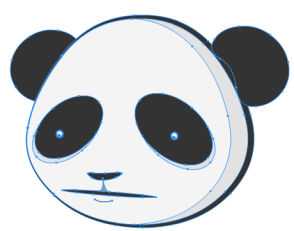
To draw lines and shapes, use the Pencil tool, in much the aforementioned fashion that you lot utilise a real pencil to depict. To apply smoothing or straightening to the lines and shapes as you draw, select a cartoon manner for the Pencil tool.
-
Select the Pencil tool
 .
. -
Select Window > Properties and select a stroke color, line weight, and style.
-
Select a drawing mode under Options in the Tools panel:
- To depict straight lines and convert approximations of triangles, ovals, circles, rectangles, and squares into these mutual geometric shapes, select Straighten
 .
.
- To depict smooth curved lines, select Smooth
 .
.
- To draw freehand lines with no modification applied, select Ink
 .
.

Lines drawn with Straighten, Polish, and Ink mode, respectively. - To depict straight lines and convert approximations of triangles, ovals, circles, rectangles, and squares into these mutual geometric shapes, select Straighten
-
To draw with the Pencil tool, Shift-drag to constrain lines to vertical or horizontal directions, click the Phase, and drag.
The Castor tool draws castor-similar strokes. It creates special effects, including calligraphic effects. Select a brush size and shape using the Brush tool modifiers.
Animate scales the brush size proportionately to the changing zoom level of the stage. This allows you to draw seamlessly adjusting to any zoom level and preview your work as you depict. If you want to revert to the before default behavior of brushes maintaining a constant pixel size even when you lot change the zoom level of the phase, you must disable the 'Stage zoom level' checkbox in the castor Property Inspector.
If you lot disable the Stage zoom level checkbox, the brush size for new strokes remains constant even when you change the magnification level for the Stage. So, the same castor size appears larger when the Stage magnification is lower. For case, suppose you lot set the Stage magnification to 100% and pigment with the Brush tool using the smallest castor size. So, y'all modify the magnification to 50% and paint again using the smallest brush size. The new stroke that y'all paint appears 50% thicker, uniform and accurate without any non-tapering ends than the earlier stroke and (Irresolute the magnification of the Stage does non change the size of existing brush strokes.)
Use an imported bitmap as a fill when painting with the Castor tool.
If yous have a Wacom pressure-sensitive tablet continued to your calculator, vary the width and bending of the brush stroke. This can be achieved by using the Castor tool Force per unit area and Tilt modifiers, and varying pressure on the stylus.
The Force per unit area modifier varies the width of brush strokes when y'all vary the pressure on the stylus. The Tilt modifier varies the angle of castor strokes when y'all vary the angle of the stylus on the tablet. The Tilt modifier measures the angle between the top (eraser) end of the stylus and the top (n) edge of the tablet. For case, if y'all hold the pen vertically confronting the tablet, the Tilt is 90. The Pressure and Tilt modifiers are both fully supported for the eraser function of the stylus.
On a tablet, the Tilt and Pressure level options for Castor Tool function only when you use the Pen mode. The mouse manner does not enable these options.
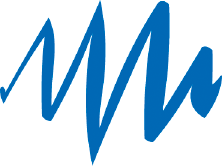
-
Select the Castor tool
. -
Select Window > Properties and select a make full color.
-
Click the Brush Mode modifier and select a painting mode:
Paint Normal
Paints over lines and fills on the same layer.
Paint Fills Just
Paints fills Merely, skips painting on strokes & empty areas.
Paint Behind
Paints in blank areas of the Phase on the same layer, leaving lines and fills unaffected.
Paint Selection
Applies a new fill to the option when you select a fill in the Make full Colour command or the Fill box of the Belongings inspector, the aforementioned as selecting a filled expanse and applying a new make full.
Paint Inside
Paints the fill up in which you lot starting time a brush stroke and never paints lines. If y'all kickoff painting in an empty area, the fill doesn't affect whatever existing filled areas.
-
Select a brush size and brush shape from the Castor tool modifiers.
-
To zoom the castor proportionately to the zoom level of the stage as you increment or subtract it while yous draw, select the Zoom size with phase check box. This allows you to draw seamlessly adjusting to whatsoever zoom level and preview your work equally you lot draw.
-
If a Wacom pressure-sensitive tablet is attached to your computer, select the Pressure level modifier, the Tilt modifier, or both, to modify brush strokes.
- Select the Pressure modifier to vary the width of your castor strokes by varying the pressure on your stylus.
- To vary the bending of your brush strokes by varying the bending of the stylus on the Wacom pressure-sensitive tablet, select the Tilt modifier.
-
Drag on the Phase. To constrain brush strokes to horizontal and vertical directions, Shift-drag.
Drawing preview and output
TheTraditional Brush tool and the Paint Brush
  tool take been enhanced in the CC 2022.1 release to give you lot much more accurate and smoother drawing experience. The final stroke that will be generated is now very close to the alive preview. With this, you do not see whatsoever unpredictable thinning or thickening of the brush strokes. Even the finer curves drawn using brush tool do non evidence whatever breakages or gaps.
Create custom brushes
The Brush Tool allows you to custom-define a brush past setting parameters of the castor such as shape and angle. This enables you lot to create natural artwork in your projects past customizing the brush tool to adapt your cartoon needs. Y'all can cull, edit and create a custom brush in Animate through the Property Inspector, when the brush tool is selected in the toolbox. To learn how to create, edit, and delete custom brushes, see Custom Brushes.
Pressure and Tilt in Paint Brush
Using Pressure and Tilt modifiers
Breathing provides Pressure and Tilt support for strokes drawn using the Paint brush tool. Yous can draw art and blueprint strokes with variable width, dependent on the applied pressure or tilt on the stylus. For further refinement, use the Width tool to adjust the width points.
For more data, see Working with PaintBrush.
Force per unit area and tilt icons in the tool bar are displayed simply if you take connected a Wacom pressure-sensitive tablet to your computer.
Brush Library
Animate has an integrated global library for Vector Brushes that includes a vast collection of Art and Pattern brushes. To launch the Castor Library Console, clickWindows > Castor Library or click on the Brush icon in the Property Inspector. Before using any brush, double-click any brush to add it to your electric current document.
Import new Vector Brushes from CC Libraries
You can import new Art and Blueprint Brushes to your Animate document using the CC Libraries in addition to the brush presets available by default. To add together a new Art or Blueprint Brush, open the CC libraries panel and just click on any of the supported brushes. (Animate currently supports only Illustrator brushes from CC Libraries.) For adding new brushes to your CC Library, you lot can apply the Castor App for Android and iOS. Clicking on a brush in CC Library adds it to both the global Brush Library panel and the current document.
You can utilise any castor as either an Art or Pattern brush. Past default, the brushes are added every bit Fine art brushes. To modify it to a Pattern brush, use the Edit brush choice and select the Brush type as Pattern brush.

Editing brushes
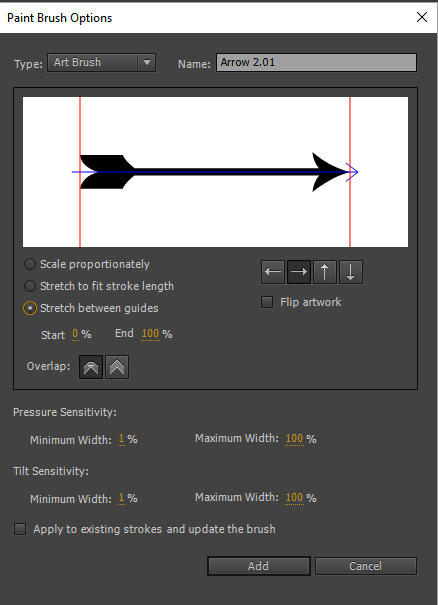
The Edit Brush icon launches the Castor editing dialog box for the selected brush. If you select an Art Castor for editing, the Art Brush Options dialog box appears. You tin can modify backdrop such as brush management, scaling preferences, and overlap preference, and utilize the changes to the existing strokes.
For more than information, see Working with Paint Castor.
The Width tool allows you to embellish a stroke by adding widths of varying thickness. Variable width can and so be saved every bit Width Profiles that can be applied to other strokes. You tin can select the Width tool from the Tools panel or using the Keyboard Shortcut (U).
When you mouseover a stroke with the Width tool selected, points (Width Point) appears on the stroke with handles (Width Handle). You lot can adjust the stroke width, move the width point, re-create the width point, and delete the width bespeak. The Width information is displayed in the Info Panel when you change Width of a stroke.
Y'all tin as well select multiple Width Points, and perform any of actions (move, copy, or delete) mentioned earlier.
For multiple strokes, the Width Tool adjusts only the active stroke. If you want to adjust a stroke, mouse-over the stroke using the Width Tool.
Variable Width Strokes are converted to Uniform strokes, if a file containing variable width stroke is opened using an older version of Animate.
To add width to a stroke, exercise the following:
- Describe a stroke or shape using any of the tools. For case, Line tool.
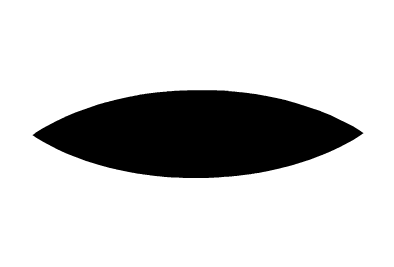
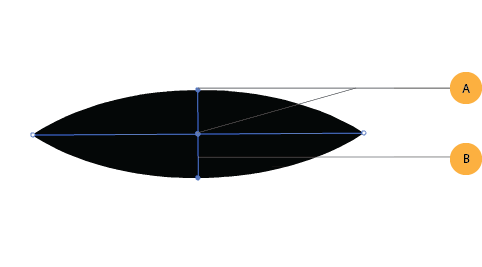
- With the betoken selected using the Width Tool, elevate the Width Handle outwards.
The size of the Width is constrained to 100 pixels on either side of the Width betoken.
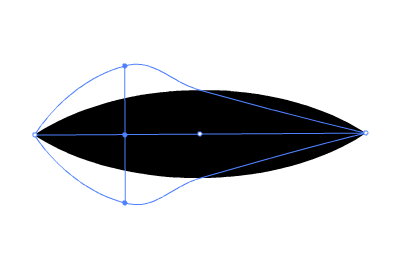
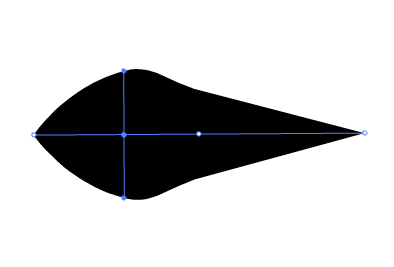
- You can see that variable width is added to stroke. Select the Width Tool and mouseover the stroke, this displays the new Width Point and Width Handle.
Moving or copying variable width practical to a stroke
You can move or re-create Width Points created for a stroke, which in effect, moves or copies variable width applied to stroke. To move a width signal, do the following:
- Select the Width tool
 from the tools console.
 - Mouseover the stroke to display existing width points, and select the Width Point you lot want to move.
- Drag the Width Indicate along the stroke.
Movement of the Width Signal is constrained by the next successive Width Indicate on either sides.
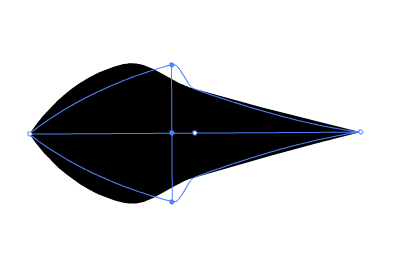
- Width bespeak is moved to its new location, and thereby likewise modifying the stroke accordingly.
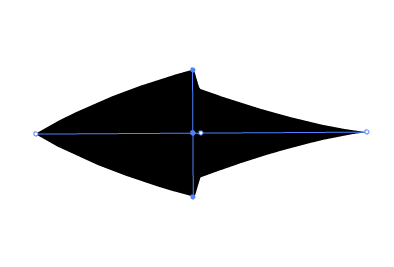
To copy a Width Indicate, do the following:
- Select the Width tool from the tools panel.
- Mouseover the stroke to brandish existing Width Points, and select the betoken you lot desire to copy.
- Concord Alt ( Pickfor Mac) and drag the width signal along the stroke to copy the selected Width bespeak.
Motion of the signal is constrained by the next successive Width Indicate on either sides.
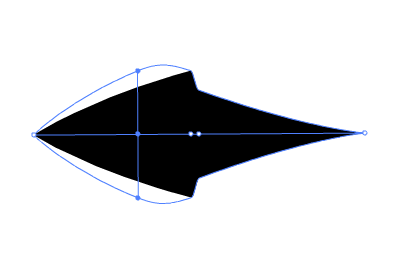
- Width point is copied. This likewise modifies the stroke accordingly.
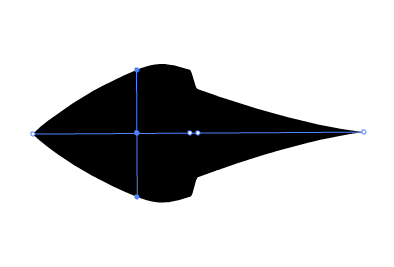
Modifying variable width of a stroke
Modifying the variable width of a stroke at whatsoever Width indicate, expands or contracts the stroke proportionally on either sides of the Width Point. However, if you want to alter the width on whatsoever i side of the point, do the post-obit:
- Select the Width tool from the tools panel.
- Mouseover the stroke to display existing Width Points, and choose the Width Point from either ends of the Width Handle that yous want to modify.
- Agree Alt ( Option for Mac) and drag the Width Handle outwards to modify the selected Width Bespeak.
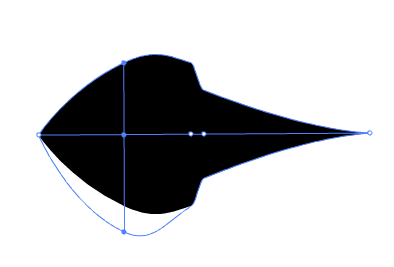
- The Width point is moved, and the stroke is modified appropriately.
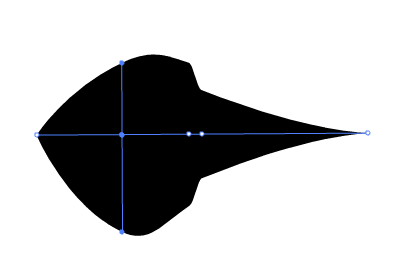
Deleting variable width of a stroke
To delete a Width bespeak, practise the following:
- Mouse over and select the Width point you want to delete.
- Printing Backspace or Delete to delete the Width indicate.
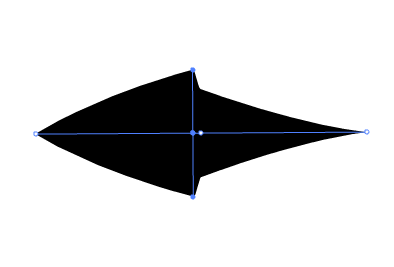
Width tool controls
The post-obit table lists the keyboard modifiers to utilise while working with the Width tool:
| Width control tasks | Keyboard modifiers |
| Create non-uniform widths | Alt+drag (Windows) or Opt+drag (Mac Bone) |
| Create a copy of the width betoken | Alt+elevate the width indicate (Windows) or Opt+elevate the width betoken (Mac Bone) |
| Copy and move all the points along the path | Alt+Shift+drag (Windows) or Opt+Shift+drag (Mac Bone) |
| Select multiple width points and drag them | Shift+click+drag |
| Delete selected width points | Delete |
Saving width profiles
After defining the stroke width, you lot can save the variable width profile from the Properties Inspector.
- Select the stroke to which you added variable width.
- Click the + button to the right of Width drop-downwardly on Backdrop Inspector.
- On the Variable Width Profile dialog, enter a Profile Name .
- Click Ok .
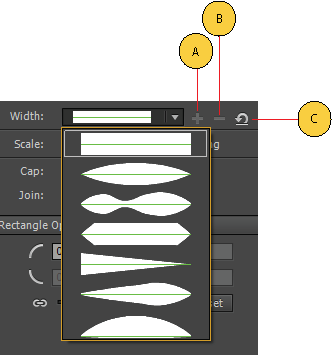
Width profiles can then exist applied to selected paths by choosing them from the Width Contour drib-down listing in the Properties Panel. When a stroke with no variable width is selected, the list displays the Uniform option. To restore the default width profile gear up, click the Reset Profiles push.
Salve width profile is enabled merely when variable width apart from default width profiles is selected on the stage. You can create your own stroke profiles using width tool and salvage them. Similarly, delete width profile icon is enabled when custom width profile is selected in the drop down. In example y'all desire to delete whatever custom contour, you can apply this pick.
Restoring the default width contour prepare in the PI, removes any custom saved profiles. You also sync the customs saved profiles to the deject.
Alive Color Preview
Live Color Preview feature displays the stroke and make full colors simultaneous when cartoon a shape on the stage. Information technology allows you to preview the nigh-final appearance of a shape when cartoon. This feature is enabled for all drawing tools available inside Animate.
The Live Colour Preview feature is too enabled for Color Swatches inside Animate. This allows you to preview changes of stroke or fill colors for a selected shape on the Phase. By hovering the arrow over a desired color, you can meet the color modify.
Live Color Preview is enabled for color swatches in the following panels:
- Tools panel
- Properties Inspector (PI)
- Phase PI
- Text PI
- Grid
- Guides


Source: https://helpx.adobe.com/animate/using/draw-simple-lines-shapes.html
Posted by: zielinskithencerest1951.blogspot.com
0 Response to "How To Draw A Line In After Effects"
Post a Comment